


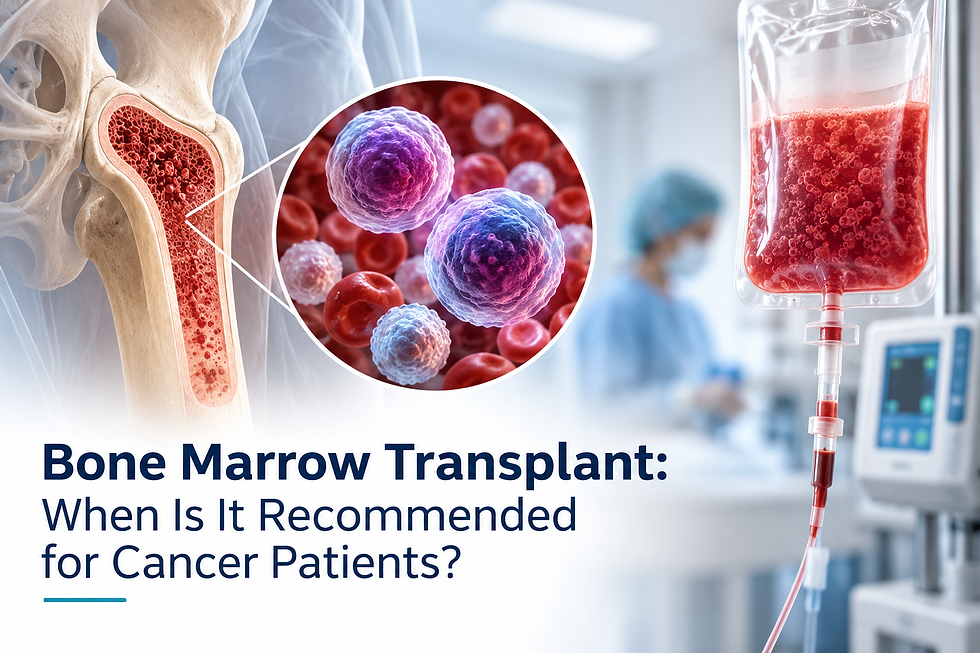
Bone Marrow Transplant: When Is It Recommended for Cancer Patients?

The words "bone marrow transplant" can sound frightening to patients and families. Many people assume that a transplant is required whenever cancer treatment is unsuccessful or that it is an extremely risky procedure.
The reality is more nuanced.
A bone marrow or stem cell transplant is an important treatment option for selected patients with certain blood cancers. It is not required for every patient, and the decision depends on the type of cancer, its response to treatment, the patient's overall health and several other factors.
What is a bone marrow transplant?
The term bone marrow transplant is commonly used, but doctors increasingly use the term stem cell transplant.
Blood cells are produced in the bone marrow. Stem cells in the bone marrow give rise to red blood cells, white blood cells and platelets.
In a stem cell transplant, healthy blood-forming stem cells are given to a patient after intensive treatment.
There are two major types.
Autologous transplant
In an autologous transplant, the patient's own stem cells are collected and stored before high-dose treatment. They are then returned to the patient.
This approach is commonly used in conditions such as multiple myeloma and selected lymphomas.
Allogeneic transplant
In an allogeneic transplant, stem cells come from another person, usually a suitably matched donor.
This approach may be used for selected patients with conditions such as acute leukemia and other high-risk blood disorders.
Why is a transplant needed?
The basic principle is different for autologous and allogeneic transplantation.
With an autologous transplant, very high-dose treatment can be given to eliminate cancer cells, after which the patient's previously collected stem cells are returned to help the bone marrow recover.
With an allogeneic transplant, the treatment may also provide an important graft-versus-cancer effect, in which donor immune cells can recognize and attack remaining cancer cells.
Which cancers may require a transplant?
Stem cell transplantation may be considered in selected patients with:
· • Acute myeloid leukemia
· • Acute lymphoblastic leukemia
· • Certain high-risk myelodysplastic syndromes
· • Multiple myeloma
· • Hodgkin lymphoma
· • Certain non-Hodgkin lymphomas
However, the word selected is important.
Two patients with the same cancer may have completely different treatment plans.
Does every leukemia patient need a transplant?
No.
This is one of the most important misconceptions.
For some leukemias, chemotherapy, targeted therapy or other modern treatments may be sufficient.
For other patients—particularly those with high-risk disease or a high risk of relapse—an allogeneic stem cell transplant may offer an important chance of long-term disease control or cure.
The decision may depend on genetic characteristics of the leukemia, response to initial treatment, measurable residual disease, age, fitness and availability of a suitable donor.
When is transplant performed?
Timing is critical.
A transplant is generally more effective when the disease is controlled or in remission, although the exact approach depends on the disease.
Your oncologist or transplant specialist will consider the response to treatment, risk of relapse and risks associated with transplantation before recommending it.
What happens before a transplant?
Before transplantation, the patient undergoes a detailed evaluation.
This may include:
· • Blood tests
· • Heart and lung evaluation
· • Kidney and liver assessment
· • Infection screening
· • Imaging when appropriate
· • Assessment of overall fitness
· • Donor matching and testing, when an allogeneic transplant is planned
The purpose is to determine whether the patient is fit enough to undergo the procedure and to identify and address potential risks beforehand.
What happens during the transplant?
Patients usually receive a conditioning treatment before stem cells are infused.
Conditioning may involve chemotherapy, radiation therapy or a combination, depending on the disease and transplant strategy.
The stem cells are then given through an intravenous line, somewhat like a blood transfusion.
The stem cells travel to the bone marrow and begin producing new blood cells.
The period immediately following transplantation is particularly important because blood counts can remain very low until the new marrow starts functioning.
What are the risks?
Stem cell transplantation can be life-saving, but it is not a simple procedure.
Potential complications include:
· • Infections
· • Low blood counts
· • Bleeding
· • Organ complications
· • Mucositis
· • Infertility
· • Graft-versus-host disease after an allogeneic transplant
· • Relapse of the underlying cancer
Graft-versus-host disease, or GVHD, occurs when donor immune cells attack the patient's tissues. It can affect organs such as the skin, liver and gastrointestinal tract.
Because of these risks, transplantation should be performed in an experienced transplant centre with appropriate supportive facilities.
How long does recovery take?
Recovery varies considerably.
The initial hospital stay may last several weeks, depending on the type of transplant and complications.
Even after blood counts recover, the immune system may take much longer to fully recover, particularly after an allogeneic transplant.
Patients may therefore need regular follow-up, infection precautions, vaccinations at appropriate times and monitoring for late complications.
Is a transplant a cure?
A transplant can potentially provide long-term remission or cure in some cancers.
However, it does not guarantee that the cancer will never return.
The chances of success depend on the cancer type, disease status at transplant, biological characteristics, patient fitness, transplant type and several other factors.
Is stem cell transplant suitable for older patients?
Age alone does not necessarily rule out transplantation.
Doctors increasingly consider physiological fitness rather than chronological age alone.
A fit older patient may sometimes be considered for transplant, while a younger patient with significant medical problems may not be an appropriate candidate.
Reduced-intensity transplant approaches have also expanded the possibility of transplantation for some patients who may not tolerate traditional conditioning.
How should patients decide?
A transplant is a major decision and should be discussed carefully with the treating hematologist or medical oncologist and, when appropriate, a transplant specialist.
Patients should understand:
· • Why transplant is being recommended
· • What alternative treatments are available
· • The expected benefits
· • Short- and long-term risks
· • The expected hospitalization and recovery period
· • The risk of relapse without transplant
· • The expected quality of life after treatment
It can also be helpful for patients to seek a second opinion at an experienced transplant centre before making a decision.
Take-home message
A bone marrow or stem cell transplant is not automatically required for every patient with blood cancer.
For carefully selected patients, however, it can be a potentially life-saving treatment and, in some diseases, may offer the best chance of long-term disease control or cure.
The decision should always be individualized based on the cancer biology, treatment response, patient fitness, transplant risks and available alternatives.
The right question is not simply, "Do I need a transplant?" but rather, "What is the potential benefit of transplant for my particular cancer, and does that benefit outweigh its risks?
Need Guidance About Bone Marrow or Stem Cell Transplant?
If a bone marrow or stem cell transplant has been recommended, or you would like to understand whether it may be appropriate for your condition, consult Dr. Amol Akhade for an evaluation based on your diagnosis, treatment response and overall clinical condition.
— Dr. Amol Akhade | Fortis Cancer Institute Mumbai @SuyogCancer


Comments